Home › Replacement & Cost › AC Replacement Cost
How Much Does AC Replacement Cost in 2026? (By Size, SEER2 & Region)
Quick answer
- Typical 2026 range: $3,500–$14,000 installed; most pay ~$6,600–$8,500 for a mid-efficiency system on a 1,500–2,000 sq ft home.
- Size drives the base price: a 2-ton runs ~$3,200–$6,500; a 5-ton can exceed $10,000.
- Efficiency adds up: going from minimum (14.3 SEER2) to premium (20+ SEER2) can add $1,000–$2,400+.
- Region matters: prices run 25–50% higher in the Northeast and California than the Southeast.
- New in 2026: systems ship with R-454B refrigerant (replacing R-410A), adding a ~5–10% equipment premium.
Replacing a central air conditioner costs about $3,500 to $14,000 installed in 2026, and most homeowners pay somewhere around $6,600 to $8,500 for a mid-efficiency system on a typical home. The price swings most on three things: system size (tonnage), efficiency (SEER2), and your region’s labor and code costs.
The short answer: 2026 price ranges
| Scenario | 2026 installed cost | Notes |
|---|---|---|
| Low end (small home, basic efficiency) | $3,500–$5,500 | 2-ton, ~14.3 SEER2 |
| Most common (mid-size home, mid efficiency) | $6,600–$8,500 | 3-ton, ~15–16 SEER2 |
| High end (larger home, high efficiency, add-ons) | $10,000–$14,000+ | 4–5 ton, 18–20+ SEER2, possible ductwork |
Cost by system size (tonnage)
One ton equals 12,000 BTU/hr of cooling. Bigger isn’t better — an oversized AC short-cycles, leaves the home humid, and wears out faster. The right size comes from a load calculation, not square footage alone (see how to size an AC with Manual J).
| System size | Cools roughly | 2026 installed cost |
|---|---|---|
| 2 ton (24,000 BTU) | ~900–1,200 sq ft | $3,200–$6,500 |
| 2.5 ton (30,000 BTU) | ~1,200–1,500 sq ft | $3,800–$7,200 |
| 3 ton (36,000 BTU) | ~1,500–2,000 sq ft | $4,900–$8,700 |
| 3.5 ton (42,000 BTU) | ~2,000–2,400 sq ft | $5,800–$9,500 |
| 4 ton (48,000 BTU) | ~2,400–3,000 sq ft | $6,800–$11,000 |
| 5 ton (60,000 BTU) | ~3,000–3,600 sq ft | $8,500–$13,000+ |
Square-footage matches are rough estimates only — get a Manual J load calculation before you buy.
Cost by efficiency (SEER2)
Higher SEER2 means lower energy bills but a higher purchase price. As of 2026, the federal minimum is 13.4 SEER2 in northern states and 14.3 SEER2 in the South/Southwest.
| Efficiency tier | SEER2 range | Cost impact vs. minimum |
|---|---|---|
| Minimum (baseline) | 13.4–14.3 | — |
| Mid-tier | 15–17 | +$400–$1,000 |
| High efficiency | 18–20 | +$600–$1,200 on top of mid-tier |
| Premium / variable-speed | 20+ | +$1,000–$2,400+ total |
The efficiency upgrade pays back over years, not months — it makes most sense in hot climates where the AC runs hard. In mild climates, a mid-tier unit is often the smarter value.
Know the number before anyone quotes you
Run your own system size, efficiency and region through our estimator, then hold the result up against any contractor’s bid. We are not a contractor and we do not pass on your details.
Cost by system type
What you are replacing matters as much as how big it is. These are installed 2026 ranges.
| What you replace | Typical installed 2026 | When this is the job |
|---|---|---|
| AC only | $4,500–$8,500 | Outdoor condenser and indoor coil, keeping your existing furnace and ductwork. The most common “my AC died” job. |
| Furnace only | $3,800–$7,200 | A new gas or electric furnace with the AC left in place. |
| Full system | $8,200–$14,500 | Both units at once. Usually the smarter buy if either is past 12–15 years — you share the labor and get a properly matched pair. |
| Heat pump | $9,500–$18,000 | One system that heats and cools. More up front than a basic AC-plus-furnace combo, but it can lower year-round energy use in mild and moderate climates. |
What a fair quote actually includes
A quote covers more than the box in the driveway. Expect all of these, and expect them itemized:
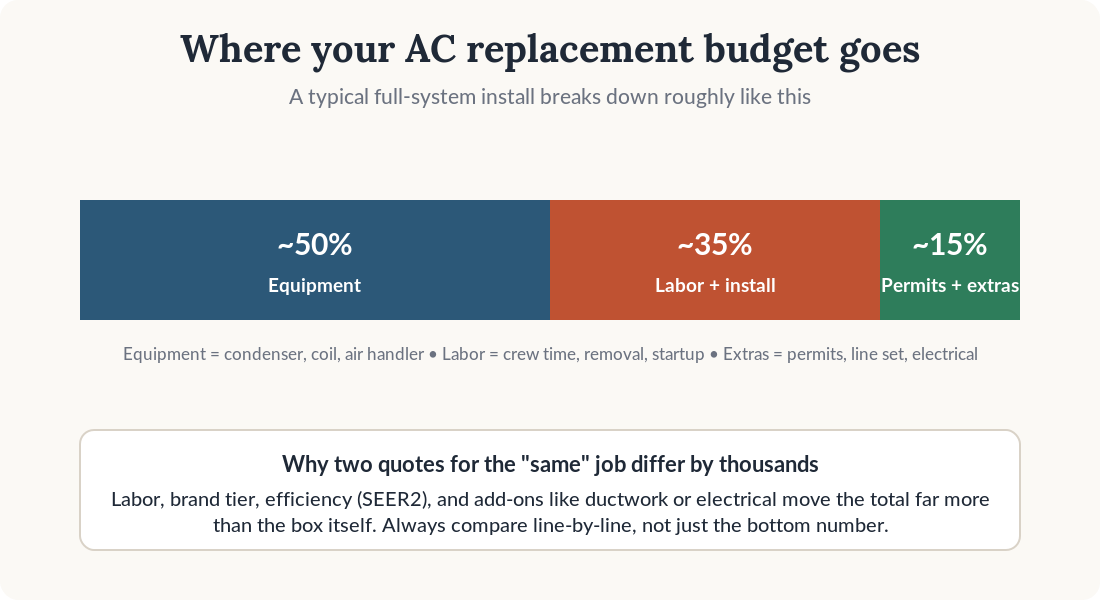
- Equipment — condenser, coil, furnace or air handler, and a new thermostat. Usually 45–60% of the total.
- Labor — removal, install, refrigerant charge, startup and testing. Roughly 40–60% of the total.
- Ductwork — if yours is leaky, undersized, or being moved.
- Permits and inspection — required in most jurisdictions, usually $100–$500.
- Code add-ons — a new line set, condensate handling, electrical disconnect, or a pad.
Where padded quotes hide. “Ductwork modifications”, “line-set replacement” and “thermostat upgrade” are the three line items to watch. Each can be completely legitimate — but ask for them broken out separately so you can compare bids like for like.
How to bring the cost down
- Get three itemized quotes. The spread between the high and low bid on the same job is routinely $2,000–$4,000.
- Buy in the off-season. Spring and fall beat mid-summer emergency pricing.
- Right-size, don’t upsize. Insist on a Manual J load calculation and don’t pay for tonnage you don’t need — see how to size an AC properly.
- Check utility and manufacturer rebates. Many local utilities and brands still offer a few hundred dollars back on high-efficiency equipment.
- Match efficiency to your climate. A 20-SEER2 system in a mild climate may never recoup its premium. Somewhere with a long, hard cooling season, it might.
When you compare the three quotes, check that each one specifies tonnage, SEER2 rating, model numbers, and whether a Manual J was actually performed. If two bids differ by thousands, it is usually one of those four lines that explains it.
Hidden cost drivers
These line items turn a $7,000 job into a $12,000 one. None are “scams” — they’re real work — but know about them before you sign.
| Add-on | Typical 2026 cost | When it applies |
|---|---|---|
| New / replacement ductwork | $3,000–$12,000+ (avg ~$3,500) | Leaky, undersized, or missing ducts |
| Electrical / panel upgrade | $500–$2,000+ | Older homes, higher-amperage systems |
| New refrigerant line set | $300–$800 | Damaged, corroded, or relocated lines |
| Permit + HERS/Title 24 test (CA) | $100–$700+ | Where local code requires it |
| Old equipment removal/disposal | $100–$500 | Almost always |
If a quote is suspiciously low, check what’s left out — disposal, permits, or a matched indoor coil are common omissions.
The 2026 refrigerant change
New ACs in 2026 use a next-generation refrigerant — most commonly R-454B — instead of older R-410A. It has ~78% lower global-warming potential, cools exactly the same, and carries a typical 5–10% price premium for updated safety components. Two things to know: you do not have to replace a working R-410A system (it’s legal and serviceable), and you cannot retrofit R-410A to R-454B — so a failed compressor or major leak on an old unit often nudges toward full replacement.