Home › Replacement & Cost › Repair or Replace
Repair or Replace Your AC? The 50% Rule for $5K–$15K Decisions
Quick answer
- The 50% rule: if a repair costs 50% or more of a new system, replacing usually wins.
- The $5,000 rule (cross-check): repair cost × unit age. Over 5,000 leans replace; under leans repair. A starting point, not gospel — 2026 prices have made it less reliable.
- Refrigerant matters: systems on R-410A or R-22 are getting expensive to recharge (R-410A jumped from ~$8–$12/lb to ~$25–$45/lb in some markets).
- Get a real diagnosis in writing first — never decide off a phone estimate or a “today only” upsell.
repair if the fix costs less than half a new system and your unit is under ~10 years old. Replace if the quote is 50%+ of replacement cost, the system is 15+ years old, or it still runs on R-410A or R-22 refrigerant. That one comparison — repair quote vs. replacement price — is the fastest way to make a $5,000–$15,000 decision without getting talked into the wrong one.
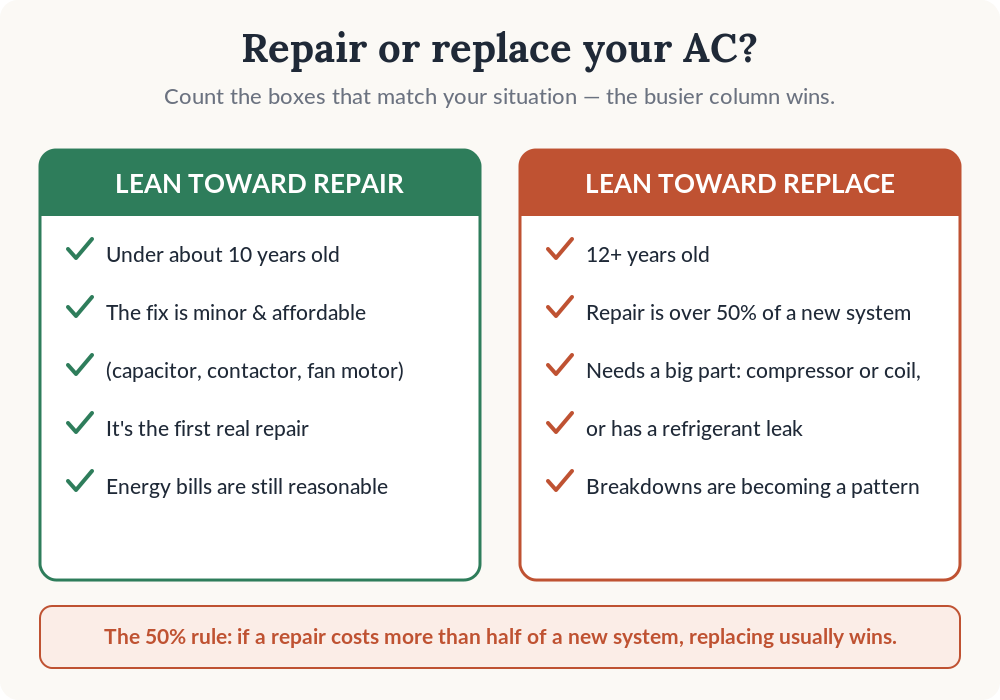
The 50% rule, explained simply
If the cost to repair your AC is 50% or more of the cost to replace it, replace it instead. A repair only buys the remaining life of an aging system; replacement buys 15+ years, lower bills, and a fresh warranty. Quick example on an $8,000 new system (50% threshold = $4,000): a $2,500 repair → repair it; a $4,500 repair → replace it.
The $5,000 rule (a cross-check)
Multiply the repair cost by the unit’s age in years. Over 5,000 leans replace; under leans repair. Example: a 12-year-old AC needing a $400 repair = 4,800 → a repair can still make sense. Honest 2026 caveat: higher equipment prices and the refrigerant phase-out have made the flat 5,000 figure less reliable — use it as a tiebreaker alongside the 50% rule and the signs below.
When the 50% rule lies
This is the part most cost guides skip. The 50% rule is about the price of one repair — but the right decision depends on more than that single number. Four situations where following it blindly costs you money.
1. A new system would cut your energy bills
This is the biggest one. A new AC at today’s minimum efficiency — 14.3 SEER2, or 15.2 in the South and Southwest — cuts cooling costs meaningfully against a worn 15-year-old unit, and high-efficiency models cut them further. If your old system is limping along at the equivalent of 8–10 SEER, a replacement pays back part of itself in lower bills. That can make replacing the right call even when the repair comes in under 50%.
Whether the premium for a higher-efficiency unit actually pays back depends on your climate and how long you plan to stay. Matching SEER2 to your home is covered in our sizing guide.
2. Your system uses R-22, or parts are getting scarce
If your AC was built before roughly 2010 it likely uses R-22 refrigerant, which has been phased out. Topping it off is expensive and getting worse. And 2026 is squeezing the next refrigerant too — R-410A recharges are climbing as it is phased down in favour of R-454B. Pouring money into refrigerant for an obsolete system is rarely worth it, and a patched older unit usually has no manufacturer warranty left, so the next failure is entirely yours.
3. You have paid for the same unit over and over
The 50% rule looks at one repair. It ignores the $400 last summer and the $600 the summer before. If you have spent $1,500–$3,000 keeping an old unit alive across two or three seasons with nothing to show for it, the cumulative math already said replace — the rule simply was not counting.
4. Reliability and timing
A unit that fails in a July heat wave is not only a repair bill. It is days without cooling, emergency-rate service calls, and the gamble that the next part goes too. If an aging system has left you sweating through repairs at the worst possible moment, reliability carries a real cost the rule never counts.
7 signs it’s time to replace
If two or more are true, replacement is usually the smarter spend:
- 15+ years old. Most central AC lasts 15–20 years; past 12, repairs stack up.
- Runs on R-22 or R-410A. R-22 now runs ~$150–$250/lb; R-410A is phasing out (new systems since Jan 2025 use R-454B), and recharge costs climb yearly.
- Energy bills keep rising even though usage hasn’t.
- 2–3+ repair calls in the last couple of years.
- The compressor failed ($800–$2,800 out of warranty — textbook 50%-rule replace territory).
- Rooms cool unevenly or it can’t hold temperature on hot days despite good airflow.
- It’s oversized or undersized (short-cycles or never shuts off) — replacement done right with a proper Manual J sizing fixes comfort and bills.
5 signs repair is the smart call
- The unit is young (under ~8–10 years).
- The broken part is minor — capacitor ($150–$400), contactor ($150–$350), thermostat.
- It’s a one-off failure, not the latest in a string.
- Efficiency is still decent and bills are stable.
- It’s under warranty (many parts warranties run 10 years if registered — you may pay labor only).
Real 2026 repair costs vs. replacement
| Repair | Typical 2026 cost | Replace instead? |
|---|---|---|
| Capacitor | $150–$400 | No — almost always repair |
| Contactor / relay | $150–$350 | No — repair |
| Refrigerant leak + recharge (R-410A) | $400–$1,500 | Maybe — if recurring or unit is old |
| Evaporator coil | $650–$2,300 | Often yes if 10+ years old |
| Condenser fan motor | $300–$700 | No — usually repair |
| Compressor (out of warranty) | $800–$2,800 | Usually yes (often >50% of new) |
| Full system replacement (installed) | $3,500–$14,000 | — |
Replacement range varies by size, efficiency, and region — see our 2026 AC replacement cost guide.
Before you commit $5K–$15K, know the range
Run your home through our estimator and walk into the conversation knowing what a fair installed price looks like. We are not a contractor and we do not pass on your details.
Run your numbers (worked example)
A 13-year-old, 3-ton central AC on R-410A; the compressor just failed. A pro quotes $2,400; a comparable new system runs ~$8,500.
- 50% rule: $2,400 ÷ $8,500 = 28% → points to repair.
- $5,000 rule: $2,400 × 13 = 31,200 → points to replace.
- Deciding factors: 13 years old, phasing-out refrigerant, lost its most expensive component. Even though the single repair is under 50%, age + refrigerant + compressor failure tip this firmly toward replace — the next failure could land within a year or two.
Use all three lenses — rule, age math, and condition — together.
Don’t get talked into the wrong choice
The repair-or-replace moment is where bad contractors make their money. Protect yourself: get a specific diagnosis in writing (a named part and price, not “it’s just old”), get the repair-vs-replace math in numbers, and get more than one quote on any big-ticket call. Related symptoms often share a root cause — see AC not cooling and frozen AC coil.
FAQ
Is it worth repairing a 10-year-old AC?
What is the 50% rule for AC replacement?
Does old refrigerant really change the decision?
Repair or Replace Your AC?
Answer a few quick questions — this runs the 50% rule and the $5,000 rule the pros use.
This is guidance, not a diagnosis. Refrigerant work is restricted to EPA-certified pros — never let anyone top off a system without finding the leak, and leave gas, electrical, and refrigerant work to a licensed pro. Always get the problem and price in writing, and get 2-3 quotes before replacing.
Estimate your replacement cost