Home › Sizing › How to Size an AC (Manual J)
How to Size an AC: Manual J Made Simple
Quick answer
- To size an AC correctly you need a Manual J load calculation — the ACCA industry standard that figures your home’s actual cooling load in BTUs, then converts to tons (1 ton = 12,000 BTU/hour).
- The “~20 BTU per sq ft” rule of thumb is a ballpark only — ACCA warns it usually oversizes equipment.
- Oversizing is the #1 sizing mistake: a too-big AC short-cycles, leaves your home clammy, and wears out faster.
- A typical 2,000 sq ft home lands around 3–4 tons — but only a load calc tells you where. See what a replacement should cost.
Sizing is the one number contractors get wrong most, and getting it wrong costs you comfort, humidity control, and money. Here’s how it actually works — in plain English, with a worked example.
What “tons” and “BTU” mean
BTU (British Thermal Unit) measures heat; your AC’s capacity is rated in BTUs removed per hour. A ton is just a bigger unit of the same thing — 1 ton = 12,000 BTU/hour, so a 3-ton AC removes 36,000 BTU/hour. “Tons” is a leftover from cooling with blocks of ice; it has nothing to do with weight. So “what size AC do I need?” really means “how many BTUs does my house gain on a hot day, and what tonnage covers that?”
The rule-of-thumb shortcut (and why it’s usually wrong)
You’ll see it everywhere: ~20 BTU per square foot, or 1 ton per 400–600 sq ft. By that math a 2,000 sq ft home “needs” ~3.5 tons. It’s a fine sanity check but unreliable as a method, because square footage ignores everything that actually drives cooling load. A 2,000 sq ft home built in 1975 might genuinely need 4 tons; the same floor area in a 2018 build often needs only 2 tons — same square footage, double the difference, because of insulation, windows, and air sealing.
What a real Manual J accounts for
Manual J is ACCA’s ANSI-recognized residential load calculation. Instead of one number, it factors in your home’s real heat gain:
- Square footage and ceiling height (volume of air to cool)
- Windows — number, size, orientation (south/west glass adds solar heat), and glazing
- Insulation in walls, attic, and floors
- Air tightness — how much hot outside air leaks in
- Climate zone — Phoenix and Seattle have wildly different loads
- Occupants (~400 BTU each) and internal heat (appliances, lighting)
- Ductwork — location, leakage, and insulation
The output is your home’s design cooling load in BTU/hour, divided by 12,000 to get tons. A professional Manual J typically runs $150–$500 — and can save far more by preventing an oversized, overpriced unit.
Worked example: a 2,000 sq ft home
| Step | Input | BTU |
|---|---|---|
| 1. Base load | 2,000 sq ft × ~25 (moderate climate) | 50,000 |
| 2. Windows | 10 standard windows, solar gain | +5,000 |
| 3. Occupants | 4 people × 400 BTU | +1,600 |
| Total cooling load | ≈ 56,600 BTU |
Convert to tons: 56,600 ÷ 12,000 ≈ 4.7 tons for this older, leakier example. A tight, well-insulated 2018 build of the same size could land closer to 2–3 tons. That spread — from 2 to nearly 5 tons — is exactly why you can’t size off square footage alone. (Illustrative simplified math; a licensed Manual J also credits good insulation and air sealing.)
Insist on a real Manual J
Ask every installer you call for the load calculation in writing, then compare them. A quote without one is a guess. We are not a contractor and we do not pass on your details.
Why oversizing fails (bigger isn’t better)
Homeowners assume a bigger AC cools better. The opposite is true. An oversized system short-cycles — blasts cold air, hits the thermostat fast, shuts off, then restarts minutes later. Because AC removes humidity only while it runs, those short cycles leave your home cold but clammy. Every start strains the compressor, so it wears out sooner — and you paid more up front for capacity that’s actively making comfort worse. Undersizing has its own issues (runs nonstop on the hottest days), but oversizing is the far more common error.
How to make sure your contractor sizes it right
- Ask for the Manual J in writing. “We’ve done this neighborhood for years” is not a load calculation.
- Be skeptical of instant tonnage. A size quoted after a 30-second look is a guess.
- Don’t accept “we’ll just match what you have.” Your old unit may have been oversized too.
- Make sure ductwork is part of the conversation (Manual D). The right AC on bad ducts underperforms.
- Get the size from more than one bidder. If three pros land near the same tonnage, trust it; if one is way bigger, ask why.
For the cost side, see our AC replacement cost guide; if your unit is on its last legs, the repair-or-replace guide walks the 50% rule. Considering ductless? Compare options in mini-split vs. central AC.
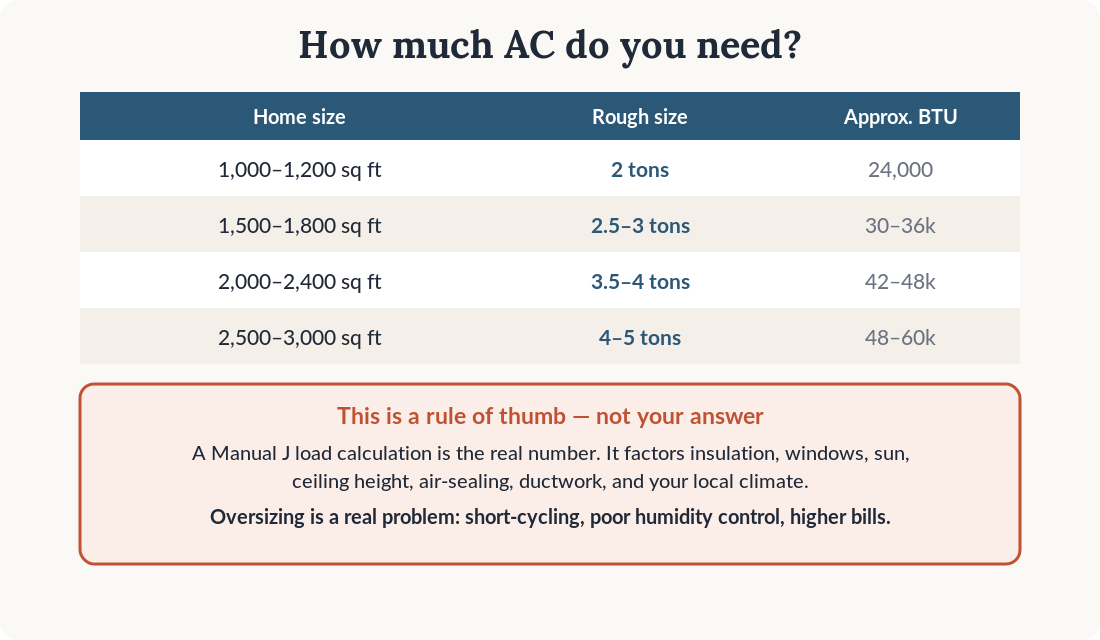
Quick reference: rough size by home size
Estimate only — get a Manual J before you buy. Ranges assume average insulation and a moderate climate.
| Home size | Rule-of-thumb load | Rough tonnage |
|---|---|---|
| 1,000 sq ft | ~18,000–24,000 BTU | 1.5–2 tons |
| 1,500 sq ft | ~27,000–36,000 BTU | 2.5–3 tons |
| 2,000 sq ft | ~36,000–48,000 BTU | 3–4 tons |
| 2,500 sq ft | ~45,000–60,000 BTU | 3.5–5 tons |
| 3,000 sq ft | ~54,000–72,000 BTU | 4.5–5 tons |